Why do many people feel that steel-cut oats and other whole-grain traditional porridges are a better choice than ordinary rolled oats or instant porridge? One key reason lies in how quickly the porridge’s carbohydrates turn into blood sugar. On this page we look at what the glycemic index means, what the research says — and why it matters for athletic performance too.
What Is the Glycemic Index?
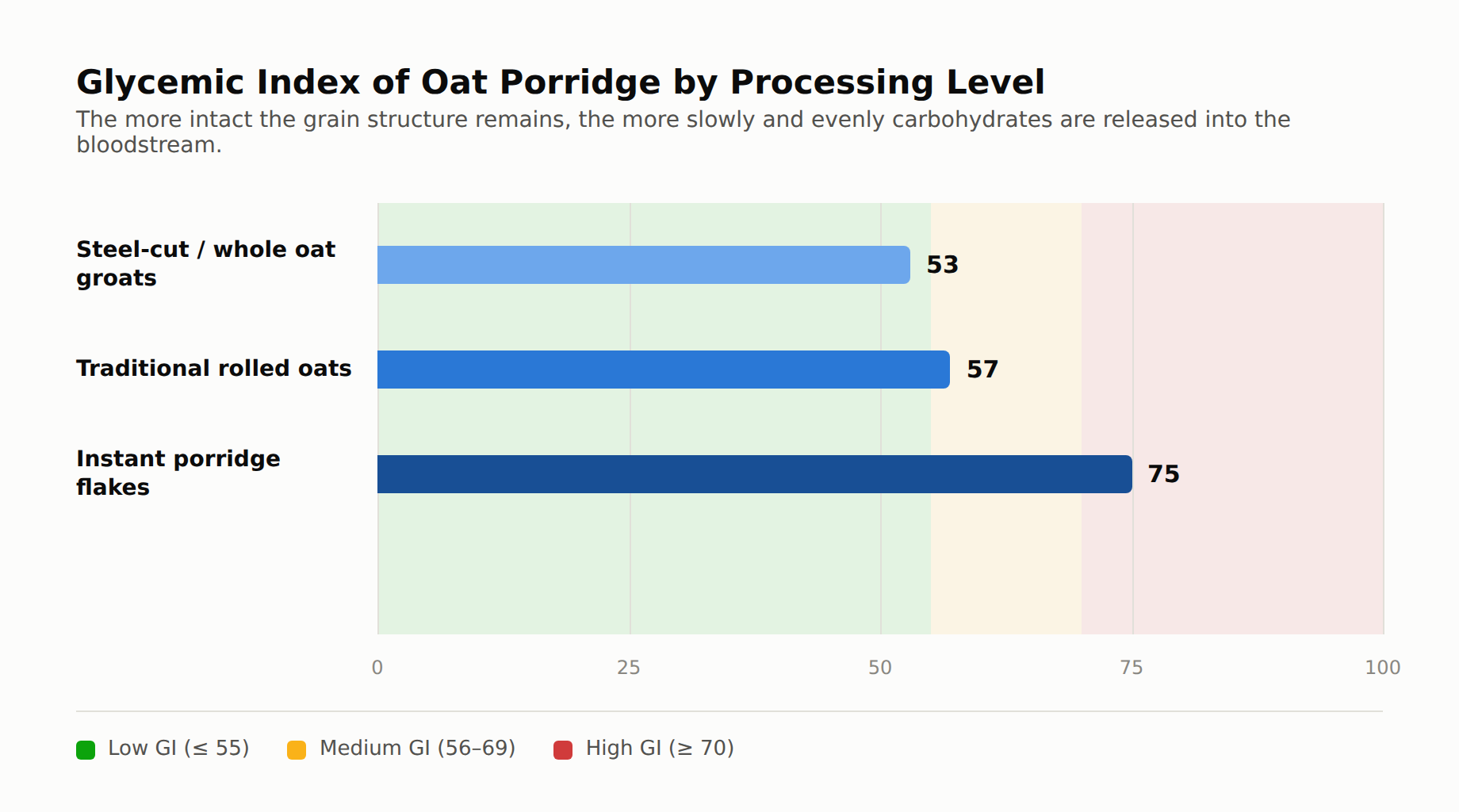
The glycemic index (GI) is a scale from 0 to 100 that describes how quickly and strongly a given food raises blood sugar after eating, compared with pure glucose. The higher the number, the faster the carbohydrates break down into sugar and enter the bloodstream — which shows up as a rapid blood sugar spike, often followed by an equally rapid drop. Foods are generally divided into three categories: low GI (55 or below), medium GI (56–69), and high GI (70 or above).
Why Does Whole-Grain Oatmeal Outperform Flakes?
The difference isn’t down to different oat products containing substantially different amounts of nutrients — fiber content is nearly the same regardless of processing level. The decisive factor is the grain’s structure. When the oat kernel is left as intact as possible, as in steel-cut groats, the starch stays locked inside the cell structure, and digestive enzymes have to work longer to reach it. When the kernel is instead rolled into thin flakes or ground and pre-cooked into instant porridge, the structure breaks down and the starch is exposed to digestion faster — blood sugar rises faster and higher.
This is backed up by a meta-analysis published in 2022 that pooled ten randomized trials and 24 comparisons of differently processed oat porridges: whole oat kernels significantly lowered the post-meal blood sugar and insulin response, thick flakes nearly as much — but thin, highly processed instant flakes showed no effect at all. The researchers’ conclusion was straightforward: breaking down the oat kernel’s structure appears to take much of its blood-sugar benefit with it.
The same pattern shows up with oats’ soluble fiber, beta-glucan: the more finely the kernel is milled, the more beta-glucan dissolves early in digestion, weakening its blood-sugar-smoothing effect. In an intact kernel, the fiber and starch stay locked inside the structure longer — and that’s exactly what produces the steadier, slower release of energy so often talked about.
What About Athletes Before a Performance?
Eating a low-GI meal before exercise has long been a popular strategy in sports nutrition, and the logic is easy to follow: a high-GI meal raises blood sugar and insulin quickly, which can impair fat burning and even lead to so-called reactive hypoglycemia right at the start of a performance — in practice, a sudden feeling of fatigue. A low-GI meal, by contrast, releases energy more slowly and evenly throughout the performance, which in theory spares muscle glycogen stores for longer.
One of the best-known studies supporting this found that a low-GI meal before a running performance improved men’s endurance running capacity compared with a high-GI meal. In fairness, it should be mentioned that a larger meta-analysis published in 2016, pooling 19 studies and 188 participants, did not find an equally clear and statistically significant overall benefit — results varied from study to study and from person to person. A likely explanation is that the benefit depends on factors such as meal timing, portion size, and individual differences in sugar metabolism.
Practical takeaway: steel-cut porridge before a performance is a reasonable and widely recommended choice precisely because of its steady energy release, but it is not a miracle cure. The best way to find the timing that works for you is to experiment and pay attention to how you feel.
Note: This page summarizes published nutrition research in plain language and does not replace personal nutrition or health advice.
Sources
- Journal of Nutrition (2022): Systematic Review and Meta-Analysis of RCTs on Oats and Oat Processing — https://jn.nutrition.org/article/S0022-3166(22)00044-X/fulltext
- American Journal of Physiology (2017): Oatmeal particle size alters glycemic index but not as a function of gastric emptying rate — https://journals.physiology.org/doi/full/10.1152/ajpgi.00005.2017
- Medical News Today: Rolled vs. steel-cut oats — https://www.medicalnewstoday.com/articles/rolled-vs-steel-cut-oats
- The Whole Grains Council: Notes on Oats — https://wholegrainscouncil.org/blog/2020/02/notes-oats
- PubMed: A low glycemic index meal before exercise improves endurance running capacity in men — https://pubmed.ncbi.nlm.nih.gov/17240783/
- Sports Medicine (2016): Effect of Glycemic Index of a Pre-exercise Meal on Endurance Exercise Performance, Systematic Review and Meta-analysis — https://link.springer.com/article/10.1007/s40279-016-0632-8